 Add to Chrome
 Add to Firefox
 Add to Edge
Weakly Supervised Object Detection
Weakly supervised object detection is the process of training object detectors with only image-level labels.
Papers and Code
SPWOOD: Sparse Partial Weakly-Supervised Oriented Object Detection
Feb 03, 2026
A consistent trend throughout the research of oriented object detection has been the pursuit of maintaining comparable performance with fewer and weaker annotations. This is particularly crucial in the remote sensing domain, where the dense object distribution and a wide variety of categories contribute to prohibitively high costs. Based on the supervision level, existing oriented object detection algorithms can be broadly grouped into fully supervised, semi-supervised, and weakly supervised methods. Within the scope of this work, we further categorize them to include sparsely supervised and partially weakly-supervised methods. To address the challenges of large-scale labeling, we introduce the first Sparse Partial Weakly-Supervised Oriented Object Detection framework, designed to efficiently leverage only a few sparse weakly-labeled data and plenty of unlabeled data. Our framework incorporates three key innovations: (1) We design a Sparse-annotation-Orientation-and-Scale-aware Student (SOS-Student) model to separate unlabeled objects from the background in a sparsely-labeled setting, and learn orientation and scale information from orientation-agnostic or scale-agnostic weak annotations. (2) We construct a novel Multi-level Pseudo-label Filtering strategy that leverages the distribution of model predictions, which is informed by the model's multi-layer predictions. (3) We propose a unique sparse partitioning approach, ensuring equal treatment for each category. Extensive experiments on the DOTA and DIOR datasets show that our framework achieves a significant performance gain over traditional oriented object detection methods mentioned above, offering a highly cost-effective solution. Our code is publicly available at https://github.com/VisionXLab/SPWOOD.

ExpAlign: Expectation-Guided Vision-Language Alignment for Open-Vocabulary Grounding
Jan 30, 2026Open-vocabulary grounding requires accurate vision-language alignment under weak supervision, yet existing methods either rely on global sentence embeddings that lack fine-grained expressiveness or introduce token-level alignment with explicit supervision or heavy cross-attention designs. We propose ExpAlign, a theoretically grounded vision-language alignment framework built on a principled multiple instance learning formulation. ExpAlign introduces an Expectation Alignment Head that performs attention-based soft MIL pooling over token-region similarities, enabling implicit token and instance selection without additional annotations. To further stabilize alignment learning, we develop an energy-based multi-scale consistency regularization scheme, including a Top-K multi-positive contrastive objective and a Geometry-Aware Consistency Objective derived from a Lagrangian-constrained free-energy minimization. Extensive experiments show that ExpAlign consistently improves open-vocabulary detection and zero-shot instance segmentation, particularly on long-tail categories. Most notably, it achieves 36.2 AP$_r$ on the LVIS minival split, outperforming other state-of-the-art methods at comparable model scale, while remaining lightweight and inference-efficient.
DExTeR: Weakly Semi-Supervised Object Detection with Class and Instance Experts for Medical Imaging
Jan 20, 2026Detecting anatomical landmarks in medical imaging is essential for diagnosis and intervention guidance. However, object detection models rely on costly bounding box annotations, limiting scalability. Weakly Semi-Supervised Object Detection (WSSOD) with point annotations proposes annotating each instance with a single point, minimizing annotation time while preserving localization signals. A Point-to-Box teacher model, trained on a small box-labeled subset, converts these point annotations into pseudo-box labels to train a student detector. Yet, medical imagery presents unique challenges, including overlapping anatomy, variable object sizes, and elusive structures, which hinder accurate bounding box inference. To overcome these challenges, we introduce DExTeR (DETR with Experts), a transformer-based Point-to-Box regressor tailored for medical imaging. Built upon Point-DETR, DExTeR encodes single-point annotations as object queries, refining feature extraction with the proposed class-guided deformable attention, which guides attention sampling using point coordinates and class labels to capture class-specific characteristics. To improve discrimination in complex structures, it introduces CLICK-MoE (CLass, Instance, and Common Knowledge Mixture of Experts), decoupling class and instance representations to reduce confusion among adjacent or overlapping instances. Finally, we implement a multi-point training strategy which promotes prediction consistency across different point placements, improving robustness to annotation variability. DExTeR achieves state-of-the-art performance across three datasets spanning different medical domains (endoscopy, chest X-rays, and endoscopic ultrasound) highlighting its potential to reduce annotation costs while maintaining high detection accuracy.
D^3ETOR: Debate-Enhanced Pseudo Labeling and Frequency-Aware Progressive Debiasing for Weakly-Supervised Camouflaged Object Detection with Scribble Annotations
Jan 06, 2026Weakly-Supervised Camouflaged Object Detection (WSCOD) aims to locate and segment objects that are visually concealed within their surrounding scenes, relying solely on sparse supervision such as scribble annotations. Despite recent progress, existing WSCOD methods still lag far behind fully supervised ones due to two major limitations: (1) the pseudo masks generated by general-purpose segmentation models (e.g., SAM) and filtered via rules are often unreliable, as these models lack the task-specific semantic understanding required for effective pseudo labeling in COD; and (2) the neglect of inherent annotation bias in scribbles, which hinders the model from capturing the global structure of camouflaged objects. To overcome these challenges, we propose ${D}^{3}$ETOR, a two-stage WSCOD framework consisting of Debate-Enhanced Pseudo Labeling and Frequency-Aware Progressive Debiasing. In the first stage, we introduce an adaptive entropy-driven point sampling method and a multi-agent debate mechanism to enhance the capability of SAM for COD, improving the interpretability and precision of pseudo masks. In the second stage, we design FADeNet, which progressively fuses multi-level frequency-aware features to balance global semantic understanding with local detail modeling, while dynamically reweighting supervision strength across regions to alleviate scribble bias. By jointly exploiting the supervision signals from both the pseudo masks and scribble semantics, ${D}^{3}$ETOR significantly narrows the gap between weakly and fully supervised COD, achieving state-of-the-art performance on multiple benchmarks.
Disentangle Object and Non-object Infrared Features via Language Guidance
Jan 14, 2026Infrared object detection focuses on identifying and locating objects in complex environments (\eg, dark, snow, and rain) where visible imaging cameras are disabled by poor illumination. However, due to low contrast and weak edge information in infrared images, it is challenging to extract discriminative object features for robust detection. To deal with this issue, we propose a novel vision-language representation learning paradigm for infrared object detection. An additional textual supervision with rich semantic information is explored to guide the disentanglement of object and non-object features. Specifically, we propose a Semantic Feature Alignment (SFA) module to align the object features with the corresponding text features. Furthermore, we develop an Object Feature Disentanglement (OFD) module that disentangles text-aligned object features and non-object features by minimizing their correlation. Finally, the disentangled object features are entered into the detection head. In this manner, the detection performance can be remarkably enhanced via more discriminative and less noisy features. Extensive experimental results demonstrate that our approach achieves superior performance on two benchmarks: M\textsuperscript{3}FD (83.7\% mAP), FLIR (86.1\% mAP). Our code will be publicly available once the paper is accepted.
Remote Sensing Change Detection via Weak Temporal Supervision
Jan 05, 2026Semantic change detection in remote sensing aims to identify land cover changes between bi-temporal image pairs. Progress in this area has been limited by the scarcity of annotated datasets, as pixel-level annotation is costly and time-consuming. To address this, recent methods leverage synthetic data or generate artificial change pairs, but out-of-domain generalization remains limited. In this work, we introduce a weak temporal supervision strategy that leverages additional temporal observations of existing single-temporal datasets, without requiring any new annotations. Specifically, we extend single-date remote sensing datasets with new observations acquired at different times and train a change detection model by assuming that real bi-temporal pairs mostly contain no change, while pairing images from different locations to generate change examples. To handle the inherent noise in these weak labels, we employ an object-aware change map generation and an iterative refinement process. We validate our approach on extended versions of the FLAIR and IAILD aerial datasets, achieving strong zero-shot and low-data regime performance across different benchmarks. Lastly, we showcase results over large areas in France, highlighting the scalability potential of our method.
${D}^{3}${ETOR}: ${D}$ebate-Enhanced Pseudo Labeling and Frequency-Aware Progressive ${D}$ebiasing for Weakly-Supervised Camouflaged Object ${D}$etection with Scribble Annotations
Dec 23, 2025Weakly-Supervised Camouflaged Object Detection (WSCOD) aims to locate and segment objects that are visually concealed within their surrounding scenes, relying solely on sparse supervision such as scribble annotations. Despite recent progress, existing WSCOD methods still lag far behind fully supervised ones due to two major limitations: (1) the pseudo masks generated by general-purpose segmentation models (e.g., SAM) and filtered via rules are often unreliable, as these models lack the task-specific semantic understanding required for effective pseudo labeling in COD; and (2) the neglect of inherent annotation bias in scribbles, which hinders the model from capturing the global structure of camouflaged objects. To overcome these challenges, we propose ${D}^{3}$ETOR, a two-stage WSCOD framework consisting of Debate-Enhanced Pseudo Labeling and Frequency-Aware Progressive Debiasing. In the first stage, we introduce an adaptive entropy-driven point sampling method and a multi-agent debate mechanism to enhance the capability of SAM for COD, improving the interpretability and precision of pseudo masks. In the second stage, we design FADeNet, which progressively fuses multi-level frequency-aware features to balance global semantic understanding with local detail modeling, while dynamically reweighting supervision strength across regions to alleviate scribble bias. By jointly exploiting the supervision signals from both the pseudo masks and scribble semantics, ${D}^{3}$ETOR significantly narrows the gap between weakly and fully supervised COD, achieving state-of-the-art performance on multiple benchmarks.
ABBSPO: Adaptive Bounding Box Scaling and Symmetric Prior based Orientation Prediction for Detecting Aerial Image Objects
Dec 10, 2025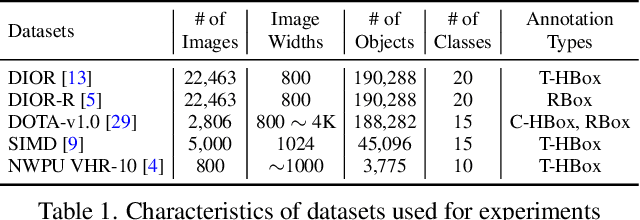
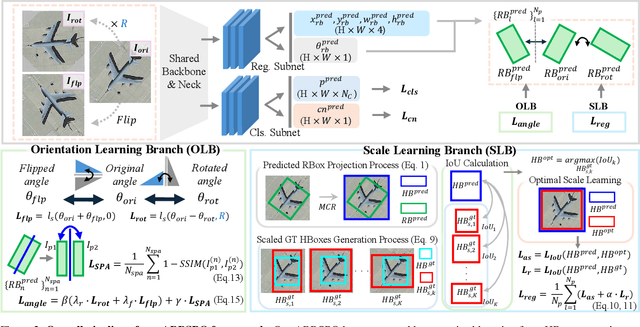
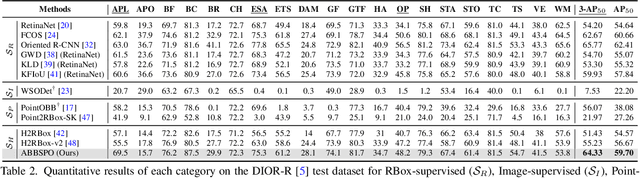
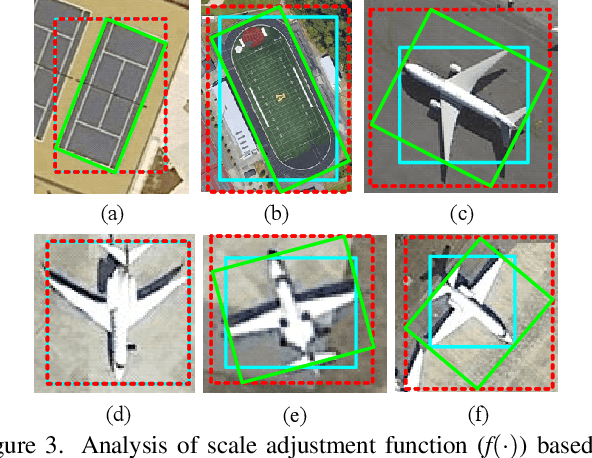
Weakly supervised oriented object detection (WS-OOD) has gained attention as a cost-effective alternative to fully supervised methods, providing both efficiency and high accuracy. Among weakly supervised approaches, horizontal bounding box (HBox)-supervised OOD stands out for its ability to directly leverage existing HBox annotations while achieving the highest accuracy under weak supervision settings. This paper introduces adaptive bounding box scaling and symmetry-prior-based orientation prediction, called ABBSPO, a framework for WS-OOD. Our ABBSPO addresses limitations of previous HBox-supervised OOD methods, which compare ground truth (GT) HBoxes directly with the minimum circumscribed rectangles of predicted RBoxes, often leading to inaccurate scale estimation. To overcome this, we propose: (i) Adaptive Bounding Box Scaling (ABBS), which appropriately scales GT HBoxes to optimize for the size of each predicted RBox, ensuring more accurate scale prediction; and (ii) a Symmetric Prior Angle (SPA) loss that exploits inherent symmetry of aerial objects for self-supervised learning, resolving issues in previous methods where learning collapses when predictions for all three augmented views (original, rotated, and flipped) are consistently incorrect. Extensive experimental results demonstrate that ABBSPO achieves state-of-the-art performance, outperforming existing methods.
High-Quality Proposal Encoding and Cascade Denoising for Imaginary Supervised Object Detection
Nov 11, 2025Object detection models demand large-scale annotated datasets, which are costly and labor-intensive to create. This motivated Imaginary Supervised Object Detection (ISOD), where models train on synthetic images and test on real images. However, existing methods face three limitations: (1) synthetic datasets suffer from simplistic prompts, poor image quality, and weak supervision; (2) DETR-based detectors, due to their random query initialization, struggle with slow convergence and overfitting to synthetic patterns, hindering real-world generalization; (3) uniform denoising pressure promotes model overfitting to pseudo-label noise. We propose Cascade HQP-DETR to address these limitations. First, we introduce a high-quality data pipeline using LLaMA-3, Flux, and Grounding DINO to generate the FluxVOC and FluxCOCO datasets, advancing ISOD from weak to full supervision. Second, our High-Quality Proposal guided query encoding initializes object queries with image-specific priors from SAM-generated proposals and RoI-pooled features, accelerating convergence while steering the model to learn transferable features instead of overfitting to synthetic patterns. Third, our cascade denoising algorithm dynamically adjusts training weights through progressively increasing IoU thresholds across decoder layers, guiding the model to learn robust boundaries from reliable visual cues rather than overfitting to noisy labels. Trained for just 12 epochs solely on FluxVOC, Cascade HQP-DETR achieves a SOTA 61.04\% mAP@0.5 on PASCAL VOC 2007, outperforming strong baselines, with its competitive real-data performance confirming the architecture's universal applicability.
Learning to Tell Apart: Weakly Supervised Video Anomaly Detection via Disentangled Semantic Alignment
Nov 13, 2025Recent advancements in weakly-supervised video anomaly detection have achieved remarkable performance by applying the multiple instance learning paradigm based on multimodal foundation models such as CLIP to highlight anomalous instances and classify categories. However, their objectives may tend to detect the most salient response segments, while neglecting to mine diverse normal patterns separated from anomalies, and are prone to category confusion due to similar appearance, leading to unsatisfactory fine-grained classification results. Therefore, we propose a novel Disentangled Semantic Alignment Network (DSANet) to explicitly separate abnormal and normal features from coarse-grained and fine-grained aspects, enhancing the distinguishability. Specifically, at the coarse-grained level, we introduce a self-guided normality modeling branch that reconstructs input video features under the guidance of learned normal prototypes, encouraging the model to exploit normality cues inherent in the video, thereby improving the temporal separation of normal patterns and anomalous events. At the fine-grained level, we present a decoupled contrastive semantic alignment mechanism, which first temporally decomposes each video into event-centric and background-centric components using frame-level anomaly scores and then applies visual-language contrastive learning to enhance class-discriminative representations. Comprehensive experiments on two standard benchmarks, namely XD-Violence and UCF-Crime, demonstrate that DSANet outperforms existing state-of-the-art methods.